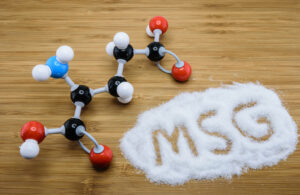
 MSG health risks should be a concern for every individual. We all know that person who can’t eat Chinese food because they’ll get a headache from the MSG. Maybe that is you. Well, guess what? It is you, and you’re eating MSG containing foods every day, even if you shop at health food stores like Whole Foods. And guess what else? You have a problem with them even if you don’t realize it – headache or no headache. It is not an allergy. It is not sensitivity. It is a toxic substance called an excitotoxin.
Excitotoxicity occurs when receptors in your body are stimulated to such a degree they are rapidly killed off. Excitotoxins are formed due to too much of the amino acid glutamic acid (glutamate), necessary in small amounts, when present in high “free” amounts. Combine the glutamate amino acid with sodium and you have MSG (Mono Sodium Glutamate). This is a glutamate problem, not one from the sodium in the MSG. Rarely is this added to food anymore as actual MSG. Rather it is made thru food processing – common foods you are eating every day. (See the bottom of this article for those hidden words.) These amino acids are artificially released during processing and your body doesn’t know how to handle so much at once. Foods you are eating from your health food store every day contain free processed glutamate. Yeah, sorry Whole Foods; MSG is rampant there too. Funny how health stores like that would never think of selling a diet soda made with NutraSweet but they have products loaded with free glutamate. There really isn’t much difference. Aspartic acid (aspartate), found in NutraSweet (Aspartame “Equal”) is also an excitotoxin. Food manufacturers will say this processing is “natural” because glutamate, (and aspartate), are natural too and your body needs them to survive. But the levels that accumulate are not natural to any degree. They are more than abnormal. They are extremely toxic.
Glutamate and MSG
Glutamate receptors lie throughout the body – especially the brain. Eating MSG foods can increase your levels 20X or higher. This is over-stimulatory and damages many cells in the body. Humans are more sensitive than any other animal on Earth and newborns are 4X more sensitive than adults. Glutamate and Aspartate pass thru the placenta and will alter brain formation. The effects of a baby in utero has been directly linked to hormonal problems later on in life – low testosterone and growth hormone in boys and low estrogen and growth hormone in girls, also leading to early onset menses, PMS, and even infertility – just from what their mother consumed. But even more alarming is the possible link to Sudden Infant Death Syndrome (SIDS) particularly due to mother’s diet if breast feeding but even more so on an infant formula-fed baby. Hydrolyzed proteins and caseinates make up the majority of these formulas and especially the soy formulas, not to mention most are close to 50% sugar. This is a great recipe for a fat, toxic baby.
Aging brains in the elderly are also four times more sensitive due to excess free iron levels in the body which increase free radical levels even more. More excitotoxins equals more free radicals. More free radicals equals faster aging. There are suspected links to Alzheimer’s and Parkinson’s as with other toxins, such as the heavy metals mercury and aluminum. Interesting though is the increase in free radical damage from too much glutamate allowing too much calcium into brain cells, so neurons fire too rapidly, and die. Normally this occurs in small amounts until the diet contains even just some bit of MSG. Yet MDs love to tell their aging patients to “get their calcium” and load them up with mega doses of the mineral. This results in flooding the brain and furthering degeneration.
But wait, there’s more!
Excitotoxin Reactions
Excitotoxins have been shown to cause the following:
- Lower blood sugar levels – especially glucose levels in the brain (that will mess up yer thinkin’). Think about how many diabetics are advised by their registered dieticians, to use NutraSweet since it is “sugar free.” Not a good idea. And consider the person who is already having memory problems not to mention some forms of dementia in the elderly.
- Damage your mitochondria (the energy centers of your cells). This equals cell death.
- Deplete magnesium (linked to heart problems and fatigue) – some research supports that 75% of the population is deficient in Mg.
- Deplete vitamin E, B vitamins, and flavonoids (powerful antioxidants found in colorful foods and herbs).
- Increase inflammation
- Suppress immunity
- Affect areas of your brain associated with emotion (MSG and NutraSweet = rage)
Aspartic acid is hidden in many nutritional supplements and is also an excitotoxin, therefore, it acts much like a MSG health risk. It is not under any tricky names though. Look for aspartic acid in the ingredients and Aspartate in the label where the minerals are listed. For example, magnesium aspartate and chromium aspartate are common. NutraSweet, commonly known as Equal, is Aspartame.
Hidden Sources of MSG
ALWAYS CONTAIN MSG: MSG, Monosodium Glutamate, Hydrolyzed Vegetable Protein, Vegetable Protein, Hydrolyzed Plant Protein, Plant Protein Extract, Sodium Caseinate, Calcium Caseinate, Yeast Extract, Textured Protein, Autolyzed Protein, Autolyzed Yeast, and Hydrolyzed Oat Flour.
FREQUENTLY CONTAIN MSG: Malt extract, Malt Flavoring, Maltodextrin, Bouillon, Broth, Stock,
Flavoring, Natural Flavoring, Natural Beef or Chicken Flavoring, Seasoning and Spices.
SOMETIMES CONTAIN: Carrageenan, Enzymes, Soy Protein Concentrate, Soy Protein Isolate, and Protein Concentrate.
Foods to watch out for include: Soybean milk (naturally high in glutamate and often has hydrolyzed vegetable protein added to it), kombu, miso, and soy sauces all contain MSG.


I would think it would be the same since they’re both from fermented soybeans. But I am not 100% sure.
Hello all,
I have a very strong, negative reaction when I consume anything containing Aspartame. Back in 1992, before I was aware of it’s dangers, I ended up in the ER with atrial fibrillation after drinking a large amount of diet soda. I have avoided Aspartame since then.
My question is this…Last year my doctor prescribed “Lantus” for my diabetes. I tolerated it well for a couple of weeks and then began having horrendous side effects. Night sweats, dizziness, high blood pressure, wavy vision, etc. The doctor tried to write it off as symptoms of hypoglycemia, but my blood sugar levels were NOT low when these reactions were taking place. I blamed it on the small amount of Aspartic Acid that is in Lantus.
He did not put any stock in that, but agreed to switch me back to oral meds for my diabetes. That worked marginally well, until now. The numbers are starting to rise again and he has now ordered Novolog 70/30. From what I can find online, it is absolutely loaded with Aspartic Acid.
I can’t find anything on this website that speaks directly to the issue of Aspartic Acid in injectible insulin. Is it a danger? Would it have the potential to cause the same side effects as Aspartic Acid in food? Any input would be appreciated.
Thanks,
Joe
Clemmons, NC
Hi Joe, this is great info you’re sharing as I’ve had a couple patients taking Lantus and did not know about the aspartic acid. Thank you. I believe in the UK they ban ALL aspartates and aspartic acid from any supplements and medication because they know the risks and problems associated with it – particularly Autism. (If anyone reading this knows otherwise, please share, but my good doctor friend who runs a nutritional company in England has told me this.)
Obviously I can’t tell you to take or not to take a med, but I can tell you that if you react to aspartic acid the way you are then sure you can definitely react to it in an injectable form. You may actually react more due to the nature which it is delivered. And here’s the thing too regarding side effects. Everybody wants to know if their symptoms from taking any med are a true side effect or not, but what I say is this: It doesn’t really matter what the drug manufacturers or studies say are side effects. What matters is how YOU react to the med. If you get a headache from it – it’s a problem. If your toenail hurts from it – it’s a problem. :) — It doesn’t matter if nobody else gets the reaction. If you do, you need to listen to that and figure it out.
Doc,
Just found the site last week, and I’ve found it super helpful.
Question for you: I use pure maltodextrin in ultras (50-100 miles) by mixing it in with water — typically a couple of hundred calories per hour. Sometimes I’ll mix it with honey or ginger. I’ve never had any major issues, but your MSG comments make me wonder whether this could cause problems.
The product I use lists maltodextrin as the only ingredient. How would I know if it contains MSG? If it does, what kind of problems, if any, could it cause if I only consume it a few races a year? Would it impact performance?
I have thought the same thing in similar products I’ve consumed for fluid and electrolyte replacement. I haven’t seen a problem myself or with patients with maltodextrin. So I think you’re okay. Symptoms from MSG toxicity can be anything from headaches & joint pain to digestive to fatigue.
Hi, thanks for the informative site. I have a Metagenics product Thermo Phase Detox and it’s first ingredient is Rice – hydrolysed. Would that contain MSG?
I’d suspect so. They may say it doesn’t but I used one of their whey products in the past that they claimed had no MSG and it was a problem.
Hi,
I have recently been diagnosed as having an intolerance to Gluten, Dairy and MSG. Gluten and Dairy are easier things to avoid, however I am having a hard time figuring out where to shop or what to buy that will result in being MSG free as it comes in many different names.
I heard going Organic will help keep MSG out, but I read somewhere else that Organic foods still have MSG in them. I am a college student who is also student teaching, so for me to have time to cook from scratch each meal is next to impossible. Also, the budget is very small. Any suggestions on where to begin when shopping for MSG free foods?
There is really no trick to it as unfortunately even products at Whole Foods contain MSG. So you have to read the labels of anything in a box/can/package.
Hi, I regularly drink soybeen milk from a brand name ‘Ades’ .
I just want to know if it’s safe to do so, or if I should avoid soy milk at all.
Thanks
I don’t think you should drink any soy milk because of the estrogen mimicking effects.
You mention above in your reply to Kieran that you did not notice a “problem” with maltodextrin i.e., “I have thought the same thing in similar products I’ve consumed for fluid and electrolyte replacement. I haven’t seen a problem myself or with patients with maltodextrin. So I think you’re okay.” The excitotoxin potential of all of the agents you mention are not going to slap you in the face and announce their presence. I think your article on Excitotoxins is fine but I think you slipped when you replied as above. Much of what goes WRONG in our bodies and minds is subclinical before the submerged iceberg makes itself clinically evident in the form of a disease.
Doc, appreciate the comment but I don’t think I slipped. I agree that you can view this as something like non-organic foods which may also not show up immediately but may build up over time and cause their problems. I see a lot of people use maltodextrin and haven’t seen it present itself as a problem when I look for the various neurological patterns that tend to exist with this type of toxicity. I’m confident, from seeing this so often and knowing the patterns which the body presents with, that it’s not a problem. Now sure you could say that some types of maltodextrin are a problem and maybe great amounts (individual dependent) might eventually take their toll, but overall I don’t think it’s an issue like the other MSG forms.
I am desperately trying to find out which foods are high in glutamate. It is feared I have ALS. Would appreciate any help. Kind Regards Natalie
Follow the guidelines in the article.
Thanks so much for sharing this sad but true information. I have been doing a research paper on MSG’s and have to present a persuasive speech to my class about the dangers of MSG’s. It’s so sad how we spend more time focusing on health care and cures when we should spend more time educating doctors and nurses on these dangers. It is hard to understand how society/government does not take this seriously as there are so many ways to prevent this. To me this is just as bad as smoking! I only hope to help encourage others to take a second look at what they are eating. Even a small decrease can make a change in my mind.
My daughter has Catamenial Epilepsy which is hormone related. Products that include soy & MSG affect her to the point that they can bring on seizures.
I spend hours checking ingredient labels in stores, and soy/MSG pretty much eliminates almost all pre-prepped food.
We have the same problems with restaurants, some of which state they don’t use either; however the jar of spice on the table usually lists MSG under one of its many alias’s.
To make matters worse, most of the soy consumed in North America is also GM which creates another set of issues.
I would love to see this stuff banned all together, but it probably won’t happen any time soon.
I am allergic to Soy and sensitive to MSG ( and life it seems). I wish the labels were more clear on what is in the foods we eat. I am in the middle of a severe outbreak, hives, rash for the last month + and cannot figure out what the cause is? Been on steroids for 3 week, hate the effects of that…frustrated..
If soybean milk is naturally high in glutamate, does this mean that the edamame (boiled soy beans) that I just bought for my salad are high in glutamate as well?
I think the main issue there with the edamame are the phytoestrogen levels, rather than the free glutamate (since it’s not processed like the soy milk). This is a good reference:
http://www.westonaprice.org/soy-alert
Hi there
Someone may have asked this before and I have missed it, but what about dogs? My dog suffers with IBS/IBD and now he suffers with epilepsy. I have tried so many things and nothing has worked so far. AND he is on phenobarb and it’s a vicious circle.
My dog has organic veg and I make it all up into a smoothie. I have changed his diet today and am trying to lay off of the aspartate and glutamate completely. I also feed some organic fruit and organic free range grass fed meaty bones.
If it was my dog then I’d start with a grain-free feed and see how that goes. If no change then I’d move to the BARF diet (Bones And Raw Food) – plenty of info on-line. Sounds like you know not to give your dog wheat or other grain byproducts which are almost always problematic.
Hi there, I live in the uk and wanted to let you know that I don t think aspartic acid is banned as I have seen it on some food products in the supermarket.
Hello. I have tried to buy ‘preservative free’ bread as I have an allergy to MSG. However, the ingredients sometimes include soy flour. Is this another form of soy MSG that I should also avoid?
Thanks,
Sharon
Some say that is indicative of MSG but regardless soy flour is an hormone disruptor, just like soy milk, and I’d personally never use or recommend either.
I am so happy to have found a site that finally understands what I have been going through for the past couple of years. I used to get horrible migraines, but it seems like as I have become older I I itch terribly after consuming anything containing processed free glutamic acid in its ingredients.
I am now thinking that this is also the cause of my itchy scalp problems and the reason I have tried possibly thirty or so different shampoos and conditioners to ease the itch and the bumps and lesions I seem to get from the products I’ve used and the dye from the hair salon. I also now think that it may not always be from the shampoo, but may be a combination of msg consumption and the shampoo. The best shampoo and conditioner I have found is John Masters Organic on the internet.
Do you have any recommendations for me? I’m still pretty miserable and am on antihistamines all the time
when i eat foods with MSG but do see it in label , i know it by one way or two . i belch and burp and also once in a while blow up like a balloon with gassy stomach , like a ulcer sensation . i thought it was good stuff , but these digestion hang ups , a clue . i do not get the other stuff headaches and so on . but the burping as i eat food and after . not a “game” but a gas up stomach , knowing the hidden material now helps .
is fermented soy such as natto considered to be in the same category as a excitotoxin?
Supposedly it is not in the same category.
A-fib and tachycardia are other possible dangers of excitotoxin consumption. I found another source of MSG after using 2 tbsps of Bragg’s aminos in gravy. MSG is naturally formed in the production, but even at 1% it is dangerous. We are so careful in choosing what we eat, but it’s hard to figure it all out. Thank you for the valuable information you provide.
Does all miso contain msg? I’ve always been taught that miso is a very healthy food… If it’s organic and unpasteurized. Also..I usually buy chick pea miso instead of soy….would it have the same level of free glutamate as soy? I read tomatoes and broccoli also contain free glutamate..so does cooking tomatoes with salt cause msg to form?
I’m not 100% sure on the miso questions because nobody gives definitive answers on these – some say all so, some say just unfermented. Plus, the levels changed based off processing, cooking, etc. Glutamate is a naturally occurring amino acid so you’re going to see it in pretty much every food. And no, cooking with or adding salt does not = MSG.
Friend of mine drove me to the grocery store yesterday and she
loves a Taiwanese restaurant. Ate some darkly brown beef with a side of lettuce, thinking it would be okay, but it must have been marinated with a super amount of MSG, because my legs were aching terribly when I got home and I woke up this morning with a headache, which I believe I only have from excitotoxins.
I enjoy a protein bar that includes non-gmo soy protein isolate. My tinnitus is greatly aggravated by glutamate. Might this soy protein isolate contain glutamate?
Hard to say. Do you own test and see how you feel when you eat them.
I am very sensitive to MSG and I’m looking for protein bars or powder. I see vegetable protein as one of the “unsafe” ingredients. Does all protein made from vegetables contain MSG? I’m questioning pea protein in particular.
I believe this typically has to do with the processing – if it’s created during the processing of the bar.
My husband has squamous cell cancer in his left lung. We are doing chemotherapy but also trying to eradicate cancer stem cells through juicing/plant based foods and supplementation. He has been using a soy protein for over 4 decades and relies on it heavily for his protein needs. We just learned today from a docu series called, “The Truth About Cancer” that soy has glutamates which feeds cancer even more than sugar. Looking for your opinion and if soy cannot be used, what alternatives for protein do you recommend?
I recommend grass fed UNdenatured whey protein. Other options would be egg or hemp.