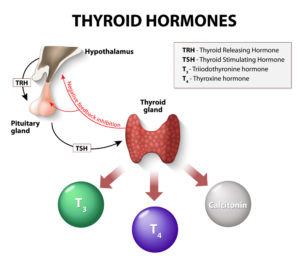
 Thyroid problems are a common occurrence. Many people take Synthroid (T4) or the natural thyroid hormone Armour Thyroid (T4 & T3). The thyroid is the most frequently tested hormonal gland today. You don’t hear too often of a woman having her estrogen or progesterone checked or a person having their adrenal function checked. Now it’s time to discuss how to optimize thyroid function!
Many people with a thyroid issue go through a period when they are hyper (high) one week (or day) and hypo (low) the next as the thyroid is trying to regulate itself. Since the thyroid is so sensitive to changes in adrenal function, estrogen production, immune function, and insulin production, you can understand why frequently the end result (or shall I say final diagnosis) s hypothyroidism as the gland is too tired to function as it should anymore.
Symptoms of Low Thyroid Function
- cold hands and feet
- dry, flaky skin
- soft, brittle fingernails
- cracking of the heels or hands
- over-emotional – cry for no reason
- thinning or balding of the hair, especially the lateral 1/3 (outside) of the eyebrows
- frequent infections
- puffy upper eyelids
- inability to lose weight
- low sex drive
- PMS
- fatigue, worse in the morning
- “foggy” thinking
- loss of memory
- depression
- morning axillary (armpit) temperature below 97.8
Let me stress how important your health is on your thyroid. If you eat too many carbs and make too much insulin, then you’ll block the major thyroid hormone T4 from converting to T3. This will also happen if you make too much cortisol (from stress). T4 conversion to T3 doesn’t even occur in the thyroid, yet physicians only want to look there. 60% of the conversion occurs in the liver and the other 40% is up to the kidneys and digestive tract.
Always address all your hormones as discussed before you go on any medication, especially a hormonal medication. And always have a complete thyroid panel done, (TSH, freeT4, freeT3), not just TSH (thyroid stimulating hormone, from the pituitary gland). Checking reverse T3 if your T4 is high and your T3 is low is a good idea. If things just don’t make sense, then investigate the many times overlooked autoimmune diseases effecting the thyroid – Grave’s and Hashimoto’s. These are called TG and TPO antibody titers. Hashimoto’s is the number one reason today for low thyroid function, worldwide. It is an immune problem, but a thyroid symptom.


I had a saliva test done about 6 yrs ago and came back low adrenal and thyroid. I took hydrocortisone (25 mg) for 3 years and Cytomel (t3 only) for about 6. I am only on Cytomel now.
I am 58 yrs old and 16 yrs postmenopausal with all hormones low. I eat a very healthy diet, however do not exercise much due to back issues.
I am toying with the idea of weaning off the cytomel, since I think my adrenals are much better now (sleeping great and less stressed) and maybe I don’t need the thyroid help anymore. Have you ever seen people recover from thyroid issues? I’ve been told that once you begin thyroid replacement its night night for your thyroid and it will never wake up again.
I’ve lost considerable amount of weight and have good energy. For these two reasons I have not stopped the cytomel.
Thank you
You’re right, it is often hard to get off a thyroid med once you’ve been on it for an extended period of time. However, often the dose can be lowered as the person’s health improves. Typically when Cytomel works well it is because the body is not converting T4 to T3 very well. This is often blocked by cortisol (stress), insulin (high carb/sugar diet), and estrogen (estrogen dominance in women, men too sometimes). So if you’re making the T4, but still need the T3, consider that. Back issues? Check out the post on back pain and the adrenal glands. Thanks!
Hi, my wife has had Hasimoto’s for most of her life. Since having our two boys she has gained significant weight and is really struggling to shift it. Do you have any advice for someone like her who has no functioning thyroid and is entirely dependant on medication to regulate her thyroid levels?
She most likely still has some functioning thyroid but the conventional treatment is to treat the thyroid when actually you should be treating the problem – the immune system. The #1 reason for Hashimotos is a gluten allergy – so that would be the easiest to try. Don’t eat any gluten. Worst thing that can happen from that is nothing and most feel better from less anyway. (But it has to be 100% removed.)
Also check out this book from a colleague of mine: http://www.amazon.com/Still-Thyroid-Symptoms-Tests-Normal/dp/1600376703/ref=sr_1_3?ie=UTF8&qid=1347145539&sr=8-3&keywords=thyroid+book
Hi Dr G, I’ve just discovered your website and it’s so helpful- thank you.
I seem to have most of these issues of low thyroid but puffy lower eyelids in the morning that most mornings begin to get watery for a few minutes when I rise. I was suspecting that this is inflammation that is diet related as it is worse when I eat wheat and sugary food. So I’ve eliminated sugar, caffeine and wheat recently to see if this helps and did vegan diet. My cravings for sweets and snacks have gone but still get puffy eyes.
Then I tried going low fodmap – no difference to puffy eyes but digestion better. I only lost 3lbs in 3 weeks.
My major concern is inabity to lose weight and gradually gaining weight despite dietary changes.
Now considering TWT to see if I’m carbohydrate intolerant which I suspect yes. The puffy morning eyes is what concerns me too, have you dealt with this?
I know it’s not a serious health issue but I’d like to know why this happens and if it signifies or could lead to other problems later.
I’m 51 and don’t do a lot of exercise. It depletes my energy which I don’t seem to have a lot of.
Thanks in advance :)